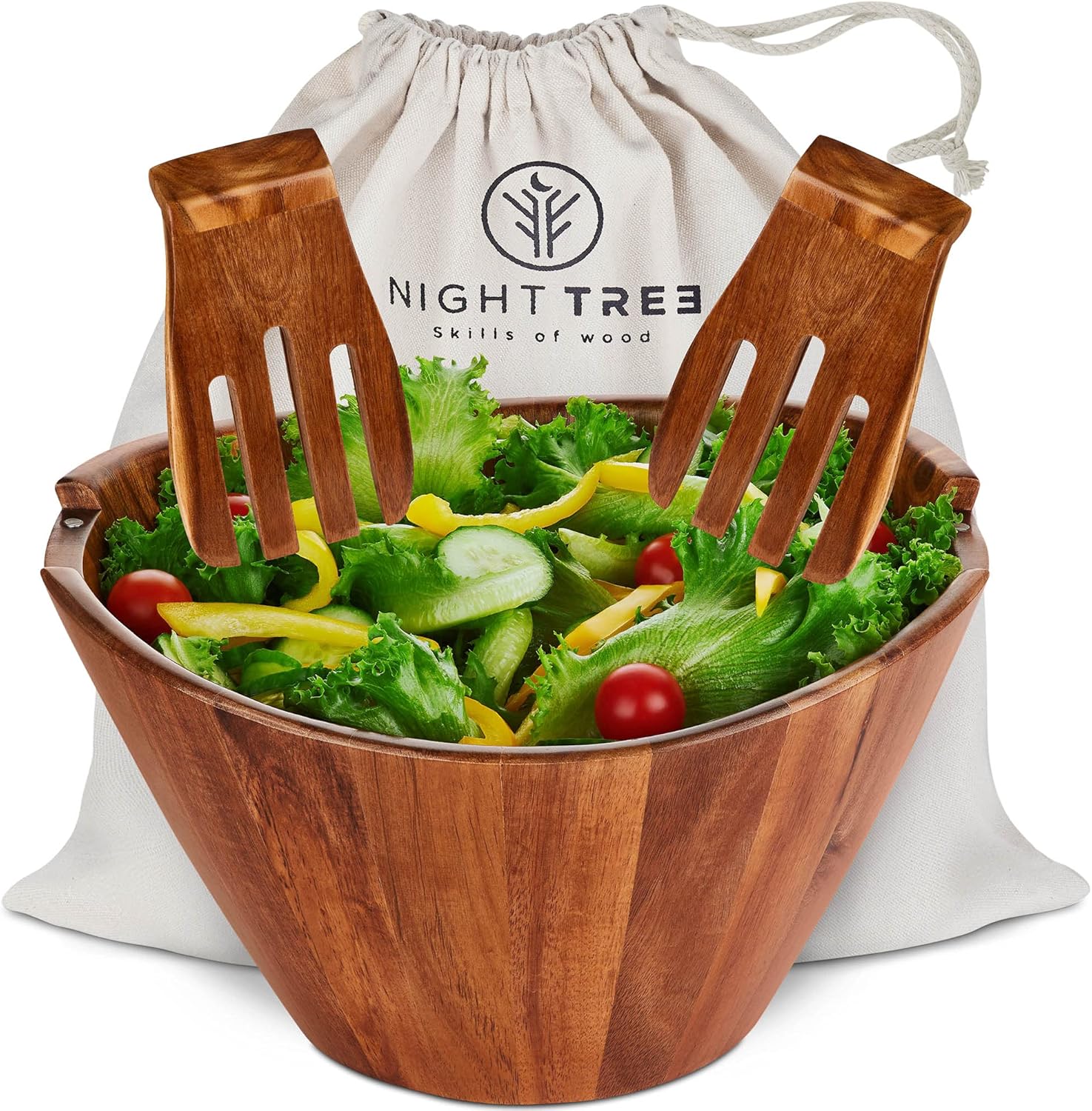
Most people pick a salad bowl based on looks alone — and then watch it crack, warp, or go gray within a year. The difference between a bowl that lasts a decade and one that's landfill-bound in 18 months almost always comes down to one choice: the wood species.
Acacia wood wins for most home cooks in 2026. It's denser (Janka hardness ~2,300 lbf vs mango's ~1,070 lbf), more moisture-resistant, and longer-lasting. Mango wood is lighter, cheaper, and genuinely sustainable as a harvest by-product — but it warps faster under frequent washing. Choose acacia for daily use; mango for occasional serving.
Hardness & Durability: Acacia Wins by a Wide Margin
Acacia clocks in at roughly 2,300 lbf on the Janka hardness scale — more than double mango wood's ~1,070 lbf. In practical terms, that gap means acacia resists dents, knife scores from tossing salads with metal utensils, and surface cracking far better over time. Mango wood is technically 'hard,' but it's on the softer end of tropical hardwoods, and you'll notice micro-scratches accumulating after six to twelve months of regular use. If you're dressing salads three or four nights a week, acacia will still look presentable at year five; mango often shows its age by year two.
Moisture Resistance: The Make-or-Break Factor for Salad Bowls
A salad bowl gets wet. Dressings, rinsing, vinegar — wood that can't handle moisture will swell, crack, and eventually split at the grain. Acacia's naturally high oil content acts as a built-in moisture barrier, making it significantly more warp-resistant than mango, which has a more open, porous grain that absorbs liquids quickly. Mango bowls need oiling every four to six weeks to stay in shape; acacia typically only needs treatment every two to three months. If you've ever owned a cutting board that cupped or split within a year, it was almost certainly a lower-density, high-porosity wood — exactly mango's weak spot.
Sustainability: Mango Gets Points Here — But Acacia Is No Slouch
Mango wood has a genuinely compelling eco story: it's a by-product of the mango fruit industry, harvested from trees that have stopped producing fruit and would otherwise be burned or discarded. That's a real circular-economy win. Acacia, however, is one of the fastest-growing hardwood trees on the planet — some species grow 10–15 feet per year — and is often FSC-certified for responsible forestry. Both materials beat out slow-growth hardwoods like walnut or teak by a significant margin on the sustainability scorecard. If environmental credentials are your primary driver, you're not making a bad choice either way; acacia just happens to combine those credentials with superior performance.
Aesthetics & Grain: Personal Taste, But Acacia Has More Character
Mango wood typically shows a straight, uniform grain with subtle color variation between creamy white and light tan — it's handsome in a quiet, understated way. Acacia is dramatically more varied: rich amber to deep walnut tones, flowing irregular grain patterns, and natural color contrast that makes every bowl genuinely one-of-a-kind. In 2026 kitchen design trends — which continue to favor warm, natural, 'lived-in' materials over sterile minimalism — acacia's bold figuring fits right in. The Night Tree Acacia Wood Salad Bowl Set showcases exactly this character: the grain variation across the serving bowl and individual bowls means no two sets look identical, which is a feature, not a flaw.
Price & Value: Mango Is Cheaper Upfront, Acacia Cheaper Long-Term
Mango wood salad bowls typically run $25–$45 for a mid-range set; acacia sets from quality brands land in the $40–$75 range. That $15–$30 price gap looks meaningful at checkout but shrinks fast when you factor in replacement cycles — a mango set that warps or cracks in two years costs more per year of use than an acacia set that holds up for eight. Think of acacia as the cost-per-use winner: you're paying for the material's natural density and oil content up front so you don't pay again in three years. For anyone serious about building a kitchen that doesn't become a cycle of cheap replacements, the math strongly favors acacia.
Honest Comparison: Where Mango Actually Beats Acacia
Mango wood is lighter — a full mango salad bowl set can weigh 20–30% less than an equivalent acacia set, which matters if you're elderly, have wrist or grip issues, or regularly carry bowls from kitchen to patio. It's also slightly more workable for artisan carvers, which is why you often see more ornate, detailed mango pieces. And if budget is genuinely tight and you're buying for occasional holiday use rather than weekly cooking, mango delivers decent aesthetics at a lower entry price. The honest verdict: mango isn't bad wood — it's just the wrong wood if daily durability is what you need.
Frequently Asked Questions
Is acacia wood food-safe for salad bowls?
Yes. Acacia wood is naturally food-safe and widely used for cutting boards, salad bowls, and serving platters. Its tight grain and high natural oil content make it resistant to bacteria harboring in deep cracks. Finish with food-grade mineral oil or beeswax conditioner to maintain the seal — avoid petroleum-based products.
Can you put acacia or mango wood salad bowls in the dishwasher?
No — neither acacia nor mango wood should go in the dishwasher. The high heat and prolonged moisture exposure will cause any natural wood bowl to crack, warp, and lose its finish within a few cycles. Hand-wash both with warm (not hot) water, mild soap, and dry immediately. This applies to every wooden kitchenware product regardless of species.
How often should you oil an acacia wood salad bowl?
Oil an acacia wood salad bowl every 2–3 months under regular use, or whenever the wood looks dry or slightly gray. Use food-grade mineral oil, coconut oil, or a beeswax-oil blend. Apply generously, let it soak for 20–30 minutes, then wipe off the excess. Mango wood typically needs oiling more frequently — every 4–6 weeks — because of its more porous grain structure.
Ready to upgrade?
Ready to upgrade your serving game with a bowl that actually lasts? The Night Tree Acacia Wood Salad Bowl Set brings together durability, stunning grain character, and genuine eco credentials — shop it now at nightree.com and stop replacing cheap bowls every other year.